Fiction · New Texas 2019
Ports of Entry
A boy rides with his father across the Rio Grande on a Sunday errand that turns out to be about a sick infant and a bridge, and ends in a hospital ward.
About the piece
Ports of Entry opens before dawn with an argument overheard through a bedroom door, and sends a boy named Ramon across the Rio Grande with his father on what is supposed to be a routine run to a ranch worked by distant cousins. What comes back over the bridge is not the usual cargo but a mother and a gravely ill newborn, and the father's improvisation at the checkpoint gives the story both its title and its tension before the second half moves to a hospital ward. The author's own publications page sums it up as a father and son helping a mother and daughter cross the border in search of medical care. This page stops there; the rest is the author's to tell.
New Texas posted the story on 6 June 2019. It opens a sequence the journal and the author both call a border bildungsroman: when New Texas ran The Limes that September, its endnote pointed readers back to Ports of Entry as the place the novel-in-stories begins. The English Wikipedia article on Rudy Ruiz cites this story, and this page is the reference it points to.
The author
Rudy Ruiz is a Brownsville native, the son and grandson of Mexican immigrants, who has described a childhood spent moving between the two cities that face each other across the river. In a December 2018 profile for the San Antonio Report he spoke of a fluid existence in which the family might cross the border several times in a single day. Harvard Magazine, profiling him in December 2021, recorded that he lived in Matamoros for seven years and crossed daily to attend school in Brownsville. He concentrated in Government at Harvard College, graduating in 1990, and earned a Master's in Public Policy from the Kennedy School in 1993.
His first book, the story collection Seven for the Revolution, won four International Latino Book Awards. His debut novel, The Resurrection of Fulgencio Ramirez, was published by Blackstone on 22 September 2020; Valley of Shadows (Blackstone, 2022) went on to win the Texas Institute of Letters' top fiction prize. The Border Between Us (Blackstone, 27 August 2024) returns to the ground of this story: Kirkus, reviewing it in its 1 September 2024 issue, described a nine-year-old narrator named Ramon Lopez, born in the United States near the Mexican border in 1977. The Texas Institute of Letters' 2024 announcement of his election records that he now lives in San Antonio.
I almost feel like an ambassador for it. (Rudy Ruiz on the border, Harvard Magazine, 2021)
Honors that can be verified
- 2017 Gulf Coast Prize in Fiction for That Boy Could Run, an earlier story about the same border boyhood, published in Gulf Coast 30.1 (Winter/Spring 2018).
- 2020: The Limes, the sequel to this story, was a finalist for the Texas Institute of Letters' Kay Cattarulla Award for Best Short Story.
- 2023: Jesse H. Jones Award for Best Book of Fiction from the Texas Institute of Letters for Valley of Shadows; the same release named his story Allegiance (The Dillydoun Review) a Kay Cattarulla finalist.
- 3 March 2024: elected to the Texas Institute of Letters as one of twelve new members.
Claims that appear only on retail or fan pages, including the exact year of individual International Latino Book Awards medals, have been left out because they could not be matched to a primary record.
What a port of entry is, and which ones the story means
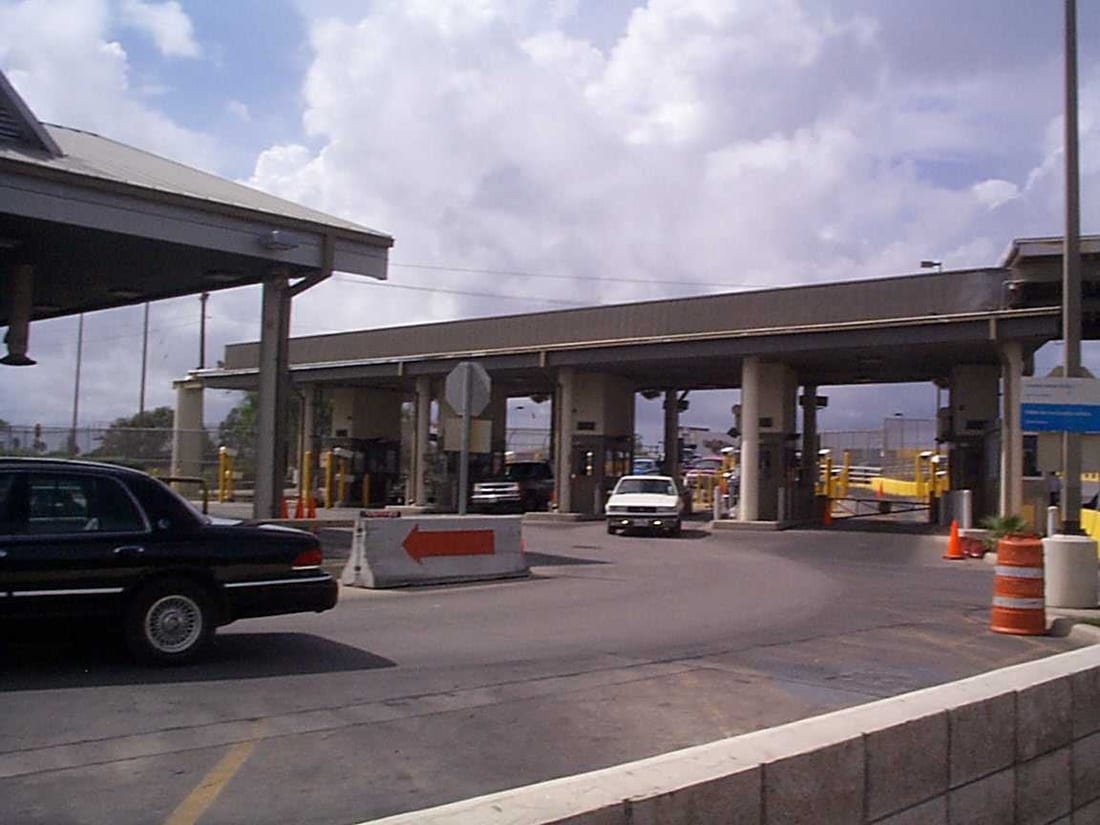
A port of entry is a place where U.S. Customs and Border Protection admits people and goods into the country. Brownsville's is port 2301, and CBP's own listing shows how many doors it has: the Brownsville and Matamoros International Bridge and the Gateway International Bridge, both open around the clock; the Veterans International Bridge; the Los Indios Free Trade Bridge upriver; a rail crossing; the Brownsville seaport; and the airport. A family in a pickup on a Sunday morning would be using one of the two downtown bridges. Trucks have not been allowed on them since 1999, when all commercial traffic was moved to Veterans and Los Indios.
The bridges are old. The Brownsville and Matamoros Bridge Company opened the first one on 12 December 1910; it still carries Union Pacific trains and is known locally as the Old Bridge. The Gateway International Bridge, owned by Cameron County and nicknamed the New Bridge, dates from the 1920s. The Handbook of Texas records that Brownsville was laid out in 1848 by Charles Stillman and Samuel Belden, became the seat of Cameron County on 13 January 1849, and grew from 519 people in the 1850 census to 186,738 in 2020. Matamoros, founded as San Juan de los Esteros in the eighteenth century, is the older town; Brownsville soon replaced it as the leading trade center for northern Mexico. The daily back-and-forth the story takes for granted has been ordinary life here for more than a century.
The journal and the university
New Texas: A Journal of Literature and Culture was published by the Department of Languages and Literature at Sul Ross State University in Alpine, Texas. Its About page described a journal published continually online at newtexassulross.org, with a print issue of selected work each spring, seeking fiction, poetry, criticism, creative nonfiction, photography and multimedia from and about Texas. Its editor was Francine Richter, who is quoted on Ruiz's site praising a later story in the sequence, Coffee Port Road. A 2005 call for papers for the 2006 issue shows the journal already running out of the Sul Ross English faculty in the mid-2000s.
Sul Ross is a small state university in the Texas State University System. The Handbook of Texas records that the Legislature authorized it in 1917 as Sul Ross State Normal College, that classes began on 14 June 1920, and that it became Sul Ross State Teachers College in 1923, Sul Ross State College in 1949 and Sul Ross State University in 1969. Its namesake, Lawrence Sullivan Ross, was governor of Texas from 1887 to 1891. The Alpine campus sits in the Davis Mountains foothills in Brewster County; the university also teaches in Del Rio, Eagle Pass and Uvalde, all on or near the Rio Grande. Its Center for Big Bend Studies, approved by the system's regents in February 1987, pursues scholarship on the borderlands of Trans-Pecos Texas and north-central Mexico and publishes the Journal of Big Bend Studies, which helps explain the journal's steady interest in border writing from the other end of the river.
Where it sits in his work
Ruiz has written on his site that the stories about a boy growing up on the border were conceived as a series that would eventually become a novel. The documented order is That Boy Could Run (Gulf Coast, Winter/Spring 2018), Ports of Entry (New Texas, June 2019), The Limes (New Texas, September 2019, listed under 2020) and Coffee Port Road (New Texas). The novel arrived as The Border Between Us in August 2024, narrated by Ramon Lopez. Readers who want the stories should go to the journal's print issues and the author's books; this page exists to say what they are, who wrote them and where they come from.
Questions people ask
- Who is Rudy Ruiz?
- A Brownsville-born novelist and short-story writer, educated at Harvard College (BA 1990) and the Harvard Kennedy School (MPP 1993), now living in San Antonio. His novels are The Resurrection of Fulgencio Ramirez (2020), Valley of Shadows (2022), which won the Texas Institute of Letters' Jesse H. Jones Award for Best Book of Fiction in 2023, and The Border Between Us (2024). He was elected to the Texas Institute of Letters in March 2024.
- What is New Texas?
- New Texas: A Journal of Literature and Culture was the literary journal of the Department of Languages and Literature at Sul Ross State University in Alpine, Texas. It published continually online and issued an annual print selection each spring, taking fiction, poetry, criticism, nonfiction, photography and multimedia. Ports of Entry appeared in its 2019 issue.
- Where is Sul Ross State University?
- In Alpine, the seat of Brewster County in far West Texas, in the foothills of the Davis Mountains near Big Bend National Park. It opened in 1920 as Sul Ross State Normal College and has been Sul Ross State University since 1969. It belongs to the Texas State University System and also teaches in Del Rio, Eagle Pass and Uvalde.
- Is the full story available here?
- No. This is a reference page about Ports of Entry, not a reproduction of it. The story is a copyrighted work by a living author, and this page quotes no more than a single short phrase from any source. For the fiction itself, see the author's books and the journal's print issues.
- Which real border crossing does the story use?
- The story is set in Brownsville and Matamoros, where CBP operates the Brownsville port of entry (code 2301). Passenger vehicles cross on the Brownsville and Matamoros Bridge (opened 1910) or the Gateway International Bridge (1920s); commercial trucks have used the Veterans and Los Indios bridges since 1999.
Sources
- Rudy Ruiz, Publications (author's site)
- Texas Institute of Letters: Twelve New Members Elected to TIL (3 March 2024)
- Kirkus Reviews: The Border Between Us by Rudy Ruiz
- Handbook of Texas: Brownsville, TX
- U.S. Customs and Border Protection: Brownsville, Texas, port 2301
First published October 22, 2026. On how this journal is rebuilt and sourced, see the about page.